
What is FSI (Floor Space Index)? How Does It Affect Your Home Purchase?
 By Admin
 August 27, 2026
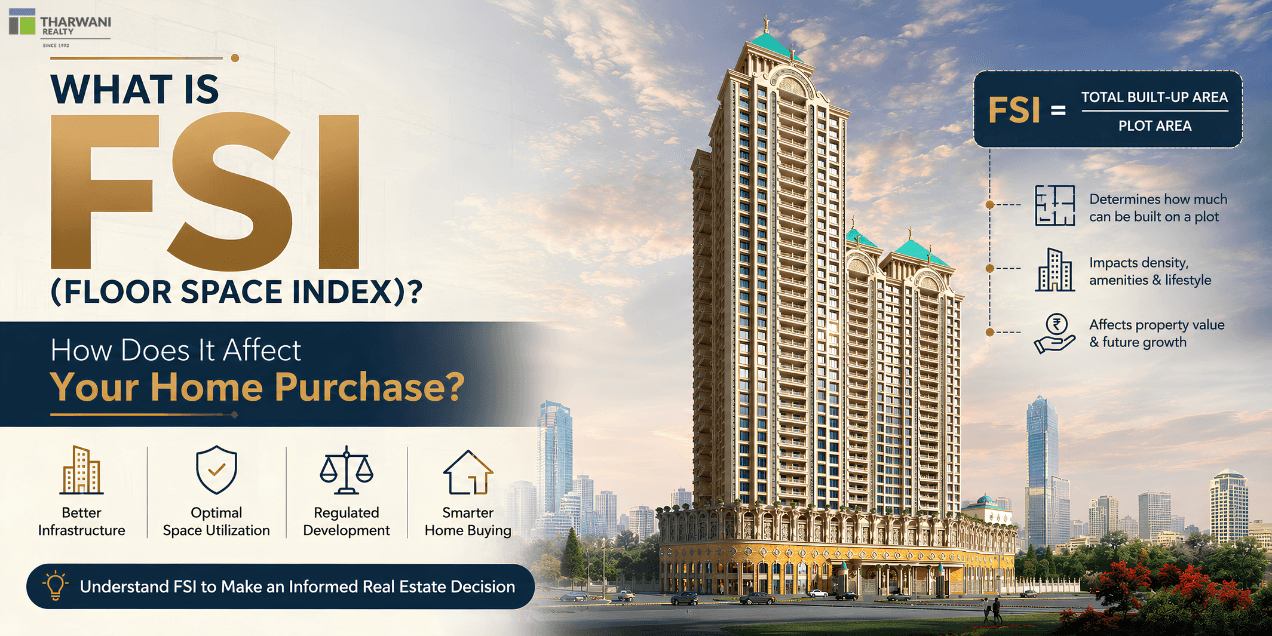
When buying a home, factors such as carpet area, price, location and amenities often take centre stage. However, there is another important factor that plays a significant role in shaping a residential project: FSI or Floor Space Index.
FSI determines how much construction is permitted on a particular plot of land. In simple terms, it influences the height and scale of a building, the number of apartments that can be developed and the amount of open space available within a project.
For example, two residential developments located in the same area may look completely different. One may have a few low-rise buildings with more open spaces, while another may consist of taller towers and a larger number of apartments. One of the key reasons behind this difference is the permissible FSI.
While FSI may not always be the first thing homebuyers consider, understanding it can provide better insight into the overall planning and density of a residential development. So, what exactly is FSI, how is it calculated and how can it affect your home purchase? Let’s understand.
What Is FSI in Real Estate?
FSI, or Floor Space Index, is essentially a rulebook number. It tells a developer exactly how much built-up area they're legally allowed to construct on a given plot of land.
Every city and municipal body sets FSI limits based on road width, zoning, infrastructure capacity, and how much strain the area can realistically handle. So a plot in a narrow residential lane and a similarly sized plot on a wide arterial road can have completely different construction limits, even though the land itself looks comparable.
In plain terms, FSI decides how tall, how dense, and how spread out a project can legally be.
FSI Full Form and What It Actually Means
The FSI full form in real estate is Floor Space Index, sometimes also called Floor Area Ratio depending on the region. It's expressed as a ratio, and that ratio is what everything else in this article builds on.
Here's the part most buyers never get told directly: FSI isn't a fixed national number. It changes based on:
- The city and even the specific zone within that city
- Whether the plot is residential, commercial, or mixed-use
- Road width fronting the plot
- Access to public infrastructure like water and drainage capacity
- Special schemes (redevelopment, slum rehabilitation, metro corridors) that unlock additional FSI
This is why the same builder can construct a 15-storey tower in one micro-market and be capped at 7 storeys a few kilometres away.
How Is FSI Calculated?
The FSI formula is straightforward once you see it written out:
FSI = Total Built-Up Area ÷ Total Plot Area
Here's a quick example I often use with first-time buyers. Say a plot measures 1,000 square metres, and the local authority permits an FSI of 2. That means the developer can construct up to 2,000 square metres of built-up area across all floors combined, not per floor.
So the builder could choose to build:
Approach | Floors | Built-up Area per Floor |
Fewer, larger floors | 4 floors | 500 sq. m. each |
More, smaller floors | 8 floors | 250 sq. m. each |
Mixed configuration | 5 floors | Varies by design |
Same FSI, very different buildings. This is why FSI alone doesn't tell you what a project will look like, but it does tell you the outer limit of what's possible.
FSI vs FAR: Are They the Same Thing?
I get asked this constantly, and the honest answer is: functionally, yes, in most Indian markets, though the terms come from slightly different planning traditions.
FSI (Floor Space Index) and FAR (Floor Area Ratio) both express the same relationship, built-up area divided by plot area. Maharashtra's planning documents primarily use the term FSI, while several international and some Indian markets use FAR interchangeably. When you're reading a project's RERA disclosure or a municipal sanction plan, don't get thrown off if you see either term. They're describing the same ceiling.
How Does FSI Affect Your Home Purchase?
This is where it stops being a technical planning term and starts affecting your actual living experience. A few ways FSI shows up in your day to day:
- Density and privacy. Higher FSI usually means more units packed onto the same plot, which can mean less open space, tighter parking, and busier common areas.
- Amenities and green space. Developers working with generous FSI sometimes still choose to under-build and dedicate the rest to gardens, clubhouses, or open plots, which is worth checking rather than assuming.
- Future redevelopment value. If a building was constructed using only part of its allowed FSI, there may be room for future redevelopment or additional construction, which can matter if you're thinking long term.
- Resale and rental demand. Projects in high-FSI zones near transit and commercial hubs often see stronger rental demand simply because of the density and connectivity around them.
- Sunlight, ventilation, and views. Neighbouring plots with unused or high FSI potential could mean a tower rising right next to your window a few years down the line.
I always tell buyers to ask the sales team directly what FSI the project has utilised, and what FSI is still available on adjacent plots. It's a fair question, and any credible developer should be able to answer it.
What Is Premium FSI and Fungible FSI?
Two terms that come up often once you dig a little deeper into approvals.
Premium FSI is additional construction potential a developer can purchase from the municipal authority over and above the base FSI, usually by paying a fee calculated on the ready reckoner rate of the area. It's a common route in dense cities where land is scarce but demand is high.
Fungible FSI refers to extra built-up area, typically up to 35 percent more in residential projects in many Maharashtra jurisdictions, that developers can use for balconies, flower beds, niches, and similar spaces, again against a premium payment. This is actually one reason modern apartments often come with larger balconies and utility areas than older buildings did. It's not just a design trend, it's a policy.
FSI in Maharashtra: What Buyers Should Know
Maharashtra, and particularly the Mumbai Metropolitan Region, has some of the most closely watched FSI regulations in the country because land here is genuinely scarce. FSI in Maharashtra varies by municipal corporation, distance from metro lines, and whether a plot falls under redevelopment or slum rehabilitation schemes, which often carry incentive FSI to make projects financially viable.
If you're buying in Thane, Kalyan, or the wider MMR belt, it's worth asking your broker or developer what base and premium FSI were applied to your specific project, since this directly shapes density, amenities, and how much room there is for the surrounding neighbourhood to still develop.
Common FSI Mistakes Buyers Make
A few patterns I see repeatedly:
- Assuming a tall building automatically means the developer overbuilt or cut corners, when it's often simply operating within a legitimately higher FSI zone.
- Not checking whether neighbouring plots still have unused FSI, which can lead to surprise construction later.
- Confusing FSI with carpet area or super built-up area, they measure entirely different things.
- Ignoring FSI utilisation when evaluating a redevelopment project's future potential.
None of these are avoidable if you simply ask the right questions before signing.
FAQs About FSI in Real Estate
1. What is FSI in real estate, in one line?
FSI, or Floor Space Index, is the ratio that determines how much built-up area a developer can legally construct on a given plot of land.
2. Is a higher FSI always better for buyers?
Not necessarily. Higher FSI can mean stronger connectivity and rental demand, but it can also mean higher density, less open space, and busier common areas, so it depends on your priorities.
3. How do I find out the FSI used in a project I'm considering?
Check the project's RERA registration documents or simply ask the developer's sales team directly, since this information should be part of the sanctioned building plan.
4. What's the difference between FSI and FAR?
FSI and FAR both express built-up area divided by plot area and are used more or less interchangeably across Indian real estate markets, with FSI being the more common term in Maharashtra.
5. Does FSI affect resale value?
Indirectly, yes. Projects in areas with higher permissible FSI often see stronger long-term demand due to better infrastructure and density, though this varies by location and how the FSI was actually utilised.